Showing posts with label Cosmetics. Show all posts
Showing posts with label Cosmetics. Show all posts

Historical makeup is one of my biggest passions. As you will discover if you continue to read my blog, I love everyday objects and artefacts. Cosmetics, magazines, accessories -- all of it. It fascinates me how something as small as a cigarette case can "hold" a lifetime of stories and memories. Powder compacts are also one of those objects. You might think they exist in a more or less similar style today. However, I would like to show you just how remarkable they once were and maybe encourage you to continue your own research. This is just a brief taste of the history of powder compacts; there are many books and publications that approach the topic in a greater and more professional manner. I am just an amateur collector and lover of the subject -- so here we go!
Above: A 1950s Max Factor "Creme Puff" Powder advert, the powder is in production to this day.
https://powdercompacts.files.wordpress.com/2011/06/1950sadvertcremepuff.png
The history of powder compacts begins with the commercialisation of makeup in the late 19th century. In essence the compact is simply a container in which to store solutions that are not liquid. Anything from creams, pastes, gels and powders can be kept within it. One of the aspects that repeatedly draws my attention is the variety of shapes and forms that this seemingly mundane object has the potential to take on.
Below are examples of two powder compacts from the 1920s. The first is a finely ornamented silver-toned loose powder compact. It contains compartments for powder, rouge and even a small mirror. Its original feature is the finger ring at the end of an attached chain. This unique element combined with the detailed guilloche pattern and rose motif adorning the lid suggest that the compact was created with two roles in mind - to serve a functional purpose while also being a fashionable accessory. It calls to mind a Renaissance pomander, albeit without the diffusing scent, and exemplifies the unique practicality and innovation often seen in vintage accessories.
Below are examples of two powder compacts from the 1920s. The first is a finely ornamented silver-toned loose powder compact. It contains compartments for powder, rouge and even a small mirror. Its original feature is the finger ring at the end of an attached chain. This unique element combined with the detailed guilloche pattern and rose motif adorning the lid suggest that the compact was created with two roles in mind - to serve a functional purpose while also being a fashionable accessory. It calls to mind a Renaissance pomander, albeit without the diffusing scent, and exemplifies the unique practicality and innovation often seen in vintage accessories.
The second example is a late 1920s cardboard powder refill box. It would have been bought to refill an empty powder compact (perhaps something similar to the one described above), hence the less durable cardboard material. Nonetheless it has held up quite well! The illustration on the lid, probably hand-coloured, depicts a woman with a slightly Asian physique surrounded by a border of floral motifs. The name of the product, the Three Flowers Boudoir Compact Powder Refiller, is fitting to the portrayed scene. This "oriental" feel, a style in vogue in the early 1930s, was of course a Western appropriation of the culture. The product is by Richard Hudnut of New York, a company I have never heard of before, but which is described on the sellers Etsy website as follows:
Richard Hudnut began his career by making perfumes for his father's pharmacy in Brooklyn. He established his own pharmacy in New York City in 1892 and by 1900 his products were sold across the United States. One of his lines was Three Flowers and by 1930 Three Flowers powder, rouge, lipstick, face cream and even eyebrow pencils could be purchased.The attention to detail on this disposable object is exemplary and I would like to subsequently focus on the powder puff, held by the seated figure, in the illustration.

https://powerofonedesigns.zibbet.com/vintage-compact-dance-purse-guilloche-compact-1920s-powder-compact-purse-rouge-compact-finger-ring-compact-purse

https://www.etsy.com/uk/listing/507950651/vintage-cosmetic-packaging-three-flowers?ref=market
The powder puff, an object rarely used in the same way today, was de rigueur in the 1920s and 30s. The most luxurious of styles were made of swan or ostrich down. The video below shows the process of its manufacture. Much like the dual functionality of the finger-ring compact, this puff includes its own pouch, so it can be easily turned inside-out and stored safely in a lady's handbag. Today, the closest we have to this form of powder application is through the use of a typical make-up sponge, yet that cannot compete with the grande size and glamorous connotation of the original powder puff!
https://www.youtube.com/watch?v=_UFxjD9ZiMY
Film ID: 760.02
Let us now move forward a couple of decades to the 1950s. Below is an advertisment for Kigu powder compacts. The Hungarian-founded company, Kigu of London, became one of most well respected powder compact manufacturers in the world. Ultimately acquired by Laughton & Sons., it merged into its rival brand -- Stratton. At the height of its popularity, Kigu's product inventory contained extraordinarily unique and creative designs and catered to a variety of budgets.
Kigu's rival -- Stratton -- was a British brand of compacts which gained popularity through the introduction of the "convertible compact". Pictured below, convertible compacts could be used for both loose or pressed powder. In the photograph you can notice the thin, round, gauze-like shield. This was placed over the compartment, once it had been filled with loose powder, to act as a sieve. Alternatively, one could buy a solid refill (a bit like buying a single eyeshadow to put into your customisable eyeshadow palette) and place it within the compact to use without the sieve.

https://powdercompacts.files.wordpress.com/2011/06/1950s-kigu-compact-magazine-ad-james-walker.jpg

https://powdercompacts.files.wordpress.com/2011/10/imgp7542.jpg

http://www.bagthejewels.co.uk/ekmps/shops/bag_the_jewels/images/vintage-stratton-powder-compact-with-lipstick-holder-within.-rare-item-1950s-sold--[4]-1701-p.jpg
The compacts were often lavishly, or eccentrically, decorated and adapted. The square Stratton compact seen above, for example, features an additional lipstick holder. Below the Stratton is another example that resembles a telephone dial! "Annie", the name on its lid, actually belongs to the actress Ann Miller (the compact was auctioned by Julien's in their summer 2009 sale). It was not uncommon to have one's initials or name embossed onto personal objects. From cigarette cases, lighters, pens, stationary and small leather goods, people would often place their initials onto the personal items they owned. This practice attests to the longevity of these items and the intimate bonds they held with their owners. Perhaps this is why owning a vintage powder compact or personal hand-written letter is a privilege that cannot be felt when dealing with items from the disposable culture of today.
The final example of a 1950s powder compacts is another Stratton product. Here I wanted to show the frequently reoccurring idea of a series. This compact features an image of a photograph by British photographer, Baron. Known for photographing performances of the ballet, Baron's images are frequently featured as the magical and feminine embellishments atop powder compact lids. Collecting one's favourite editions now becomes a buyer's desire and this practice is seen to this day. Just take a look at how often MAC collaborates with artists and celebritites to launch new limited edition lines of makeup products.

http://www.julienslive.com/view-auctions/catalog/id/66/lot/24452/ANN-MILLER-PERSONALIZED-POWDER-COMPACT

http://www.antiquepeek.com/images/Compacts/Vintage_Stratton_Powder_Compact_Ballet_Dancers1%20-%20Copy.JPG
https://www.youtube.com/watch?v=NH35f0CrlvI
Film ID: 75.08
The video above portrays the production of pressed powder makeup in a London factory in 1958. You can see the awe expressed at the innovative pressing machine as well as at the peculiar method of mixing multiple colours to create a universally matching shade. It seems very close to the colour correcting powders and concealers often advertised today!
With the advent of the 1960s many industries experienced changes in approach, due mostly to the emergence of the teenager, an independent potential customer, who is no longer interested in the seriousness of pre-war style, nor bound by the financial restrictions of the depression. Experimentation with colour and formula begins and heavier materials such as brass and silver are replaced by the modern feel of plastic. The rusty, tarnished powder compacts belonging to a girl's grandmother are no longer a desired object of inheritance but an obsolete symbol of elitism, age and limited female potential.

https://powdercompacts.files.wordpress.com/2011/06/max-factor-advert-womans-realm.jpg
In the above 1960s Max Factor advert one can see the "modern" approach in use. It portrays a group of women (female camaraderie -- thumbs up!) wearing clothes of a more practical nature (unlike the ball gowns and red lips frequently seen in adverts from previous decades) and emphasizes their busy lifestyles.
The third video I chose to add to this post is a 1972 documentation of working class women in a cosmetics factory near Surrey, England. It depicts women from the lower echelons of society performing monotonous tasks of filling bottles and packaging products. A misogynistic interviewer circles around asking questions about the tasks they perform. An at times humorous piece, the video is ultimately a testament to the difficulty experienced by many working in the seemingly glamorous cosmetics industry.
https://www.youtube.com/watch?v=R2ID2-ojiig
Film ID: 3049.01

http://i.dailymail.co.uk/i/pix/2015/03/08/2674099700000578-2985469-image-a-8_1425854057029.jpg
Perhaps this is why there are constant attempts to bring back the glamour of earlier decades. Charlotte Tilbury, among many, has designed her products with a palpable connection to glamorous makeup of the past. Lancome has also released their new "Cushion Foundation" (above photo). The product is sold in a simple plastic white compact, which can then be refilled with a new foundation-soaked-cushion-refill, once the original one gets used up. Although the new versions may not be as beautifully decorated as a vintage Stratton they are at least a nod to compacts of the past. And I did notice that last Christmas Boots offered a personalised engraving service -- we might in fact be closer to repeating history than one might think!
Related websites (leave a comment if you have any other interesting suggestions):
The British Compact Collectors' Society http://www.compactcollectors.co.uk
Compact Mirrors & Powder Compacts by Jane Vanroe https://powdercompacts.wordpress.com
Compactstory - a blog all about powder compacts http://collectingvintagecompacts.blogspot.co.uk

For a long time monogramming personal objects was not only a symbol of ownership. Engraved objects were seen as more precious and valuable and therefore, aside from one's own initials, it was common to engrave the date of a memorable occasion, an intimate phrase, family crest or a dedication. All in an effort to add personal value to an otherwise easily reproduced item. Until the 1950s objects would often come with a small empty plaque allowing one space for a small engraving -- typically two or three letter initials. Usually these were the small, everyday items, such as cigarette cases, jewellery, notebooks, powder compacts, glasses cases, watches as well as travel items such as suitcases, vanity cases, storage boxes and bags. Initials could then be engraved, embossed or embroidered onto an empty name tag or a purposely-designed plaque. While the latter two methods are still frequently in use today, it is engraving that has become a phenomenon of the past.

If you read this blog you will know that I am always on the hunt for pieces that resemble vintage products sold in the past. From time to time I come across a rare gem that has remained unchanged throughout many decades. Such was the case with this bottle of perfume. I wrote an earlier blog post about Coty's L'Aimant scent, where I stated that I am not yet converted to the often strong odour of vintage perfumes... except for one. The time has come to reveal the secret scent!
The smell in question is that of No. 4711's eau de cologne -- the toilet water hailing from the city of Cologne in Germany which quite naturally lends it its name. It can therefore be called the original eau de cologne, the one that led the way for future competitors, and became an icon in it's own right. Created by Italian perfumier Johann Maria Farina who opened business in 1709 in Cologne, Germany - the perfumed water was the first of its kind. The success of the innovative concoction was so great that it became a regularly ordered cosmetic, forming the toilette of many a king, nobleman or fashionable lady. Although today No. 4711 is seen as a fragrance directed at women, this was not always the case and for a long time it was used by both ladies and gentlemen.

No. 4711 cologne advert, c. 1911.
https://www.pinterest.com/pin/87538786482143204/

French advert for No. 4711 cologne, c. 1930.
https://www.pinterest.com/explore/4711-cologne/

A Polish ad for No. 4711 hair dye, featured in "Światowid" magazine, 13 June 1931, my personal collection.

A Polish ad for No. 4711 eau de cologne, featured in "Światowid" magazine, 13 June 1931, my personal collection.
Above I have included two advertisements from my personal collection of historical magazines. Both were featured in the Polish magazine "Światowid" (13 June 1931). Published in Kraków, the magazine ran from 1924 to 1939 and took on the form of a weekly chronicle which covered both domestic and international affairs. The first advert is actually for hair dye and states that the dye is made from nut extract and is able to dye hair from the lightest of blond to the blackest of black. The second advertisement is for the typical eau de cologne and it recommends to use the product in your morning bath or to rub your body with it in order to wake up the senses and feel energised. At the bottom of the advert it reminds buyers to check the patented blue-gold label and notes that the cologne is made entirely in the village of Dziedzice (located in the Silesian region of Poland) whose history extends as far back as the Middle Ages!
From the various publications one can see that No. 4711 was available all across Europe. Not only that, it was also able to retain it's status as a luxurious and one-of-a-kind perfume throughout the years. Although tastes have changed and it's name does not elicit the same joyous reaction it did a while ago, the company's headquarters, located in a six-floor building in Cologne, are regular visited by eager tourists and perfume aficionados. It's iconic bottle carries such an aura of glamour and modernity that it is no surprise that it is frequently used by set designers in film and theater. Most recently I saw it in the series Mr. Selfridge, where it occupied the majority of the famous department store's cosmetics counter.

No. 4711 cologne "Art of Living" advert, c. 1970.
http://www.vintageadbrowser.com/perfume-ads-1970s/5
Below: Stills from the television series Mr Selfridge, available on Netflix.


Exactly the same perfume is still available, both in store and online, at Boots - although not for £3.


Vintage perfume bottles will always have a special place in my heart. Their characteristic clean lines and statesque bottles never fail to connote classic Hollywood glamour atop any dressing table or nightstand. While the most known example of their enduring quality is undoubtedly Chanel No. 5, I am always on the look out for the unconventional, and in this case more affordable, perfumes, eau de toilettes and colognes, that women of the past liked to use.
Above: Coty's L'Aimant "The Magnet" advertisement, 1939.
http://www.vintageadbrowser.com/beauty-and-hygiene-ads-1930s/47
One of the things that always surprises me is their shared heaviness of scent. I wonder if it was the result of a particular "fashion" for heavier, more musky, smells or whether it was a necessity, resulting from the popularity of smoking and the subsequent need for more distinct and stronger scents. Whatever the reasons may be, I personally am still not convinced about the smells and in all but one case (which I will reveal in the near future) would not wear these perfumes. At least not now, while I am still young and prefer lighter notes, if any perfume at all.
Nonetheless, I like knowing that, were there ever to be a need, I can still go out and buy the same perfume ladies in the 1940s would, just down the street at my local drugstore! Coty's L'Aimant was launched in 1927 and was part of a series of cosmetic products of the same name. It was one of the first scents released by the French-founded American company, which is now probably most known for their celebrity collaborations as well as ownership of brands such as Rimmel London or Chloe fragrances. However, in the past, it was recognised as a stand-alone name and could frequently be seen advertising their newest makeup line on the back-cover of women's magazines.
I found a more in-depth review by a writer who knows more about the specific notes and ingredients - if you are looking for a more exact description of the scent and a comparison to different perfumes, here is the link.

Coty's L'Aimant c. 1960s
http://themuseinwoodenshoes.com/perfume-review-vintage-coty-laimant-parfum-de-toilette/

The same perfume currently on sale on Boots.com
http://www.boots.com/coty-laimant-parfum-de-toilette-spray-15ml-10003857
Below are some photos which I myself took while on a trip to Boots. As you can see, the perfume comes in a variety of sizes and the price is always under 15 GBP.


I haven't done a post like this in a while and they happen to be some of my favorite to read. This is my selection of items I used during summer vacation, hence the natural and pink theme.
Nobody likes a ton of stuff on their face in the hot summer months... well, I don't anyway. The pink makeup bag from Victoria's Secret I bought on sale for 50% off which I consider not bad. And since it fit the color scheme I decided to bring it with me.
Bourjois Healthy Mix Foundation in 52 Vanilla
A great natural foundation with light to medium coverage. Perfect for the summer!
Maybelline Affinitone Concealer in 02 Natural
Check our my "Monthly Favorites #1" post coming soon!
Maybelline Master Glaze Blush in Just-Pinched Pink no. 10
A very natural light pink blush in an easy-to-blend formula, great to throw in a beach bag.
Maybelline 24HR Color Tatoo in On And On Bronze no. 35
Perfect for the evening to create a more intense eye. I love it because the staying power is fantastic and it's at a drugstore price. I usually use my finger to blend it out but a brush also works (here I have the Sephora All Over Shadow brush in no. 22).
Maybelline Define-A-Lash Mascara
Not for those who like thick spidery lashes because the finish is very natural and each lash is precisely defined without any clumping! I love it for the natural look it creates.
Maybelline Dream Matte Powder in no. 04 Vanilla Rose
One of my favorite drugstore powders, I think this one can easily rival more expensive brands.
NYX Jumbo Eye Pencil in Yogurt no. 611
I brought this in case I wanted a natural eye shadow. These are very simple and easy to use and although there are better versions out there these are really not bad for the price. This color is a very wearable champagne tone with a slight sheen.
Sephora Unique Pink Lip Balm
I love this stuff! It goes with everything and creates the perfect pink pout. It's supposed to match up to the pH of ones skin and although I'm not sure that is true, the color it gives is very flattering and lasts a good amount of time. The only downside is that there seems to be a tendency to dry out the lips so keep a good lip treatment on hand.
Anastasia Beverly Hills Lip Gloss in Heiress
I'm not a fan of lipgloss in general so don't quote me on this :) The color here is what attracted my attention but the formula is quite thick so unless you can deal with hair in your gloss this is not for you. The applicator though is quite unique since it's just a flat piece of silicone so if you want to test something new out maybe give this a go?!
Victoria's Secret Makeup Bag
A good sized makeup bag to fit all your essentials.
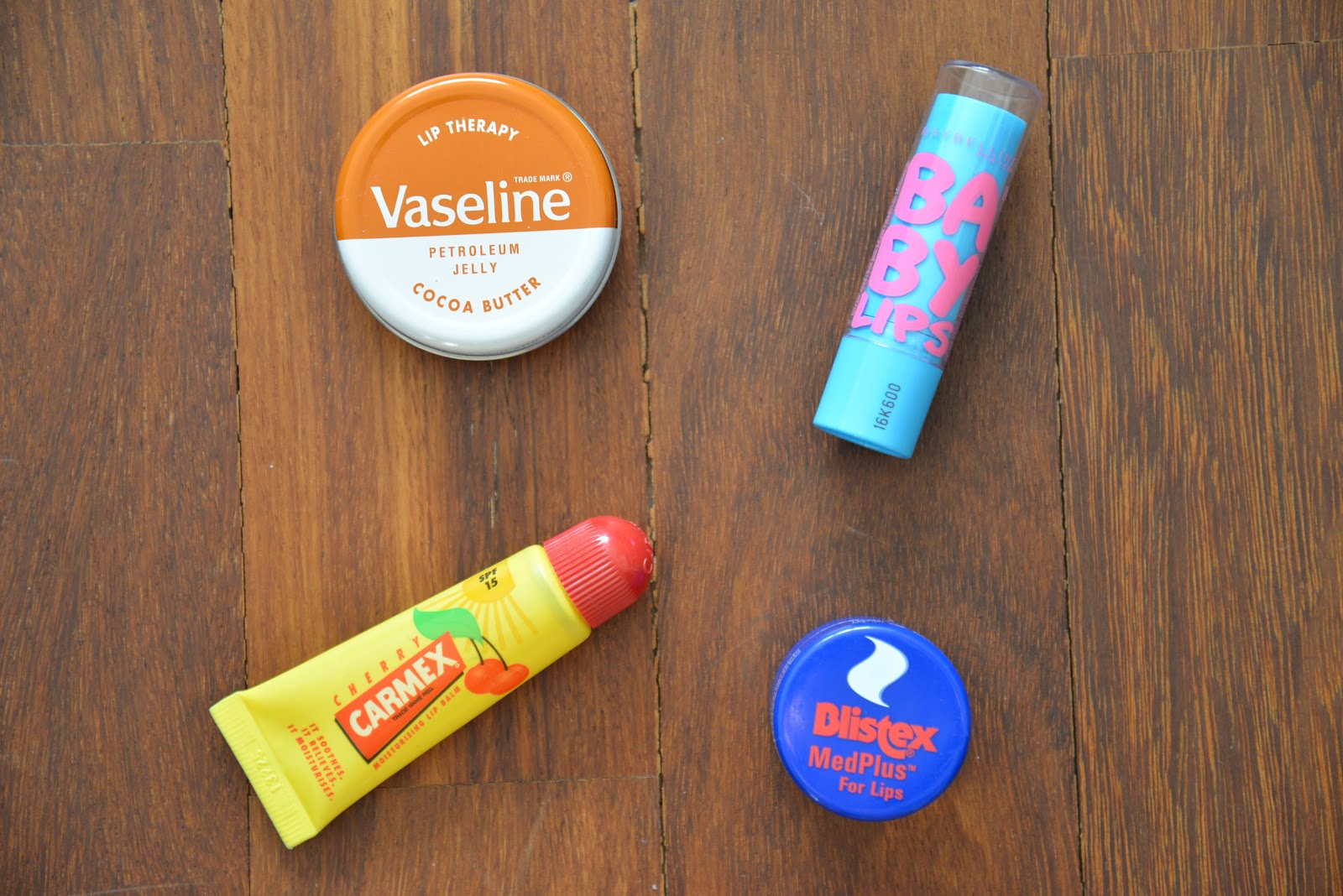
It’s posts like
these I read most often. “Why?” you may ask. Well, simply because lip balms are
one of the most basic cosmetic products. I mean… even guys use them! Since one
uses them so often it seems sensible to

Carrying on from the previous post I wanted to show you this Smashbox set I received for Christmas. It really is the perfect little assortment of products. There is a very wearable shadow palette, a classic black liner

I have decided to write a couple of posts on the pretty gifts I got for Christmas, many of which fit into the category of this blog. So, without further ado, the first one is this The Body Shop Travel Set. It contains

Since it's nearing the end of the year I thought it would make sense to do a little post about colorful makeup. I'm not usually the one to wear it on a daily basis but I think it is sometimes nice to

It's December, so there is no doubt about the winter season being in full swing. And when would red lips be more appropriate than during this time? Not only is it a Christmas associated color (I don't

Before I left for summer vacation I was looking for a neutral, everyday palette that I could take with me while I traveled. I wanted to try out something different from my Naked 2 palette and so ended up

I have always been fascinated with the past. Something about the innocence and simplicity of peoples daily lives compared to ours gets to me. Whether you look at cars, music or, as I am doing now,
Subscribe to:
Posts (Atom)


Social Icons