Showing posts with label Fashion History. Show all posts
Showing posts with label Fashion History. Show all posts

When I look at early 1950s fashion photography I notice a couple of things very clearly. Most obvious are the black and white tonality, the highly stylised set-up and the immediately distinguishable dress silhouette. But one additional aspect also rarely escapes my attention -- the refined and mannequin-like poses of the models photographed. A perfect example is visible in the photograph above by Irving Penn. The models do not interact; each is in her own world yet simultaneously fully aware of the photographer, holding her previously-planned pose for a few seconds longer. Look at the model in the centre, turned in profile towards the viewer. How could her intention be anything other than to look as noble and elegant as possible? It is the structured poses of the models, combined with the often restrictive clothing, that gave fashion photography of the early 50s an unattainable, idealistic feel, which served to showcase the perfectionist craftsmanship of haute couture.

A group of fashionable jet setters pose elegantly at the French Casino Le Touquet as they contemplate their next move in a serious game of what looks like blackjack. The moment is captured for eternity by famed photographer Richard Avedon in August 1954. It was taken around the same time as his now iconic shot of Sunny Harnett at the same location wearing an evening dress by Madame Grès. The group photograph, however, is less dreamy and hazy. Both images feature model Sunny Harnett, yet here she is focused on the game. As she stands behind fellow fashion model Renee Breton the two form an intriguing team. Both otherworldly and aloof the slinky women are grounded through their undeniable involvement in this popular game. Talk about girl power!


A seemingly simple hairstyle, the high ponytail, combed tightly towards the back of the head was all the rage among teenagers during the late 1950s. Setting new trends in order to break away from uncomfortable starched petticoats and arduous time-consuming hairdos, contemporary youth used their new fashions to turn their backs on conservative ideals and set themselves apart from the pre-war-born generation of their parents. The high ponytail is arguably the most "modern" of vintage hairstyles and one that has to this day retained its cool-factor and universal appeal.
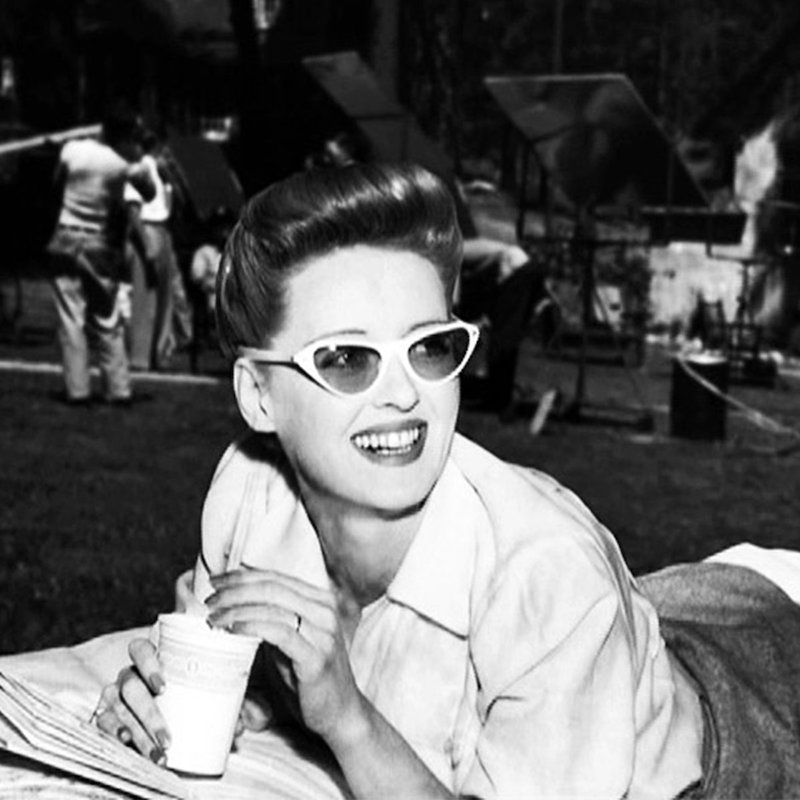
If there has ever been one actress who made sure she protected her eyes from potentially harmful UV rays then it has to be Bette Davis. Fortunately for her sunglasses were not only worn to remain safe in the presence of the bright Californian sun, they became an expression of her unique style and quirky personality too. For who else, if not Bette Davis, could be seen as a more original and frank character in Hollywood during the Golden Age of film.
Above: Davis sipping a drink on the set of Now, Voyager, 1942.
https://therake.com/stories/icons/bette-davis-stars-eyes/
From the quintessentially 1930s perfectly round shades to a pair of super slim cat eyes, that bear an uncanny resemblance to the styles visible all over Instagram today, Bette Davis undoubtedly had an affinity for this small fashion accessory. And rightly so, because it seems as though sunglasses are all she needed to complete her laid back but never careless stylish ensembles every day. Honestly, it is difficult to be surprised -- sunglasses are a great invention, it's just a matter of remembering to take them before leaving one's house in the morning!

Davis eating an ice cream, c. 1933.
https://www.pinterest.com/pin/214484000974647444/

Davis strolling in the summer, 1930s.
https://hiveminer.com/Tags/academyaward%2Cvintage

Davis knitting most likely on the set of The Old Maid, 1939.
http://historyknits.blogspot.co.uk/2010/04/knitting-before-and-behind-camera.html

Davis enjoying a cup of tea, 1940s.
https://www.pinterest.fr/pin/16677461103953777/

Davis on the set of Hush... Hush, Sweet Charlotte, 1964.
https://twitter.com/theoldhollywood/status/838550798397292545

Davis with a falcon, c. 1970.
https://mattsko.wordpress.com/2012/12/31/bette-davis-with-an-awesome-pair-of-sunglasses-and-a-falcon/

Davis attending the Cannes Film Festival with her oldest daughter, B.D., in 1963.
https://edition.cnn.com/2017/03/03/entertainment/bette-davis-joan-crawford-feud/index.html

Davis with her personal assistant Kathryn Sermak, 1980s.
https://www.gettyimages.co.uk/detail/news-photo/bette-davis-with-her-personal-assistant-kathryn-sermak-news-photo/110462069?#bette-davis-with-her-personal-assistant-kathryn-sermak-picture-id110462069
Some of my favourite Bete Davis films, all of which I highly recommend, include:
Ex-Lady (1933)
Front Page Woman (1935)
Now, Voyager (1942)
All About Eve (1950)


While fashion models in the 1960s may not
have had the same following as those immediately recognized today, they
nonetheless represented a similarly desirable lifestyle. Photographed at events, wearing clothing from the most in-demand designers, their often recognizable
physique led them to be scouted not only as models but as actresses too. It was
their budding popularity that cemented the potential influence of models today
– celebrities who do much more than just walk runways.
A number of recognizable names come to one’s
mind when thinking of iconic fashion models of the sixties. Undeniable are
Twiggy, Jean Shrimpton or Veruschka. The later even appearing as herself in the
1966 Michelangelo Antonioni film, Blowup.
The 1960s is arguably the first decade that is seen as cool in contemporary society
and the poster girls of that time were, as they are also today, beautiful,
original and provoking. Teresa Tuszyńska fit this description perfectly and, in
a short haircut calling to mind Twiggy, was to become the British models equal in
a country where fashion seemed more limited than it actually was.


When I saw Ingrid Bergman's outfits in the film Journey to Italy (1954) I could not help noticing, firstly, their timeless nature, and secondly, their modern accessories. One item that particularly caught my attention was the dark coloured leather-looking bucket bag, which Katherine Joyce (Bergman's character) carries, as she is she and her husband are being given a tour of their newly inherited Italian villa. It immediately called to mind the popular Mansur Gabriel buckets bags, which everyone was coveting not that long ago.
I find it peculiarly fascinating when items of the past resemble pieces currently sought after. One would think that what becomes desirable would be something new and fresh. Surprisingly (or maybe not) these are usually items which, if one digs back far enough, have been carried and used by men and women long ago. Just take a look at my earlier post about mesh bags!


Above: Film stills from the Roberto Rossellini film, Journey to Italy (1954).
Below: Similar styles of bags sold today (September 2017).


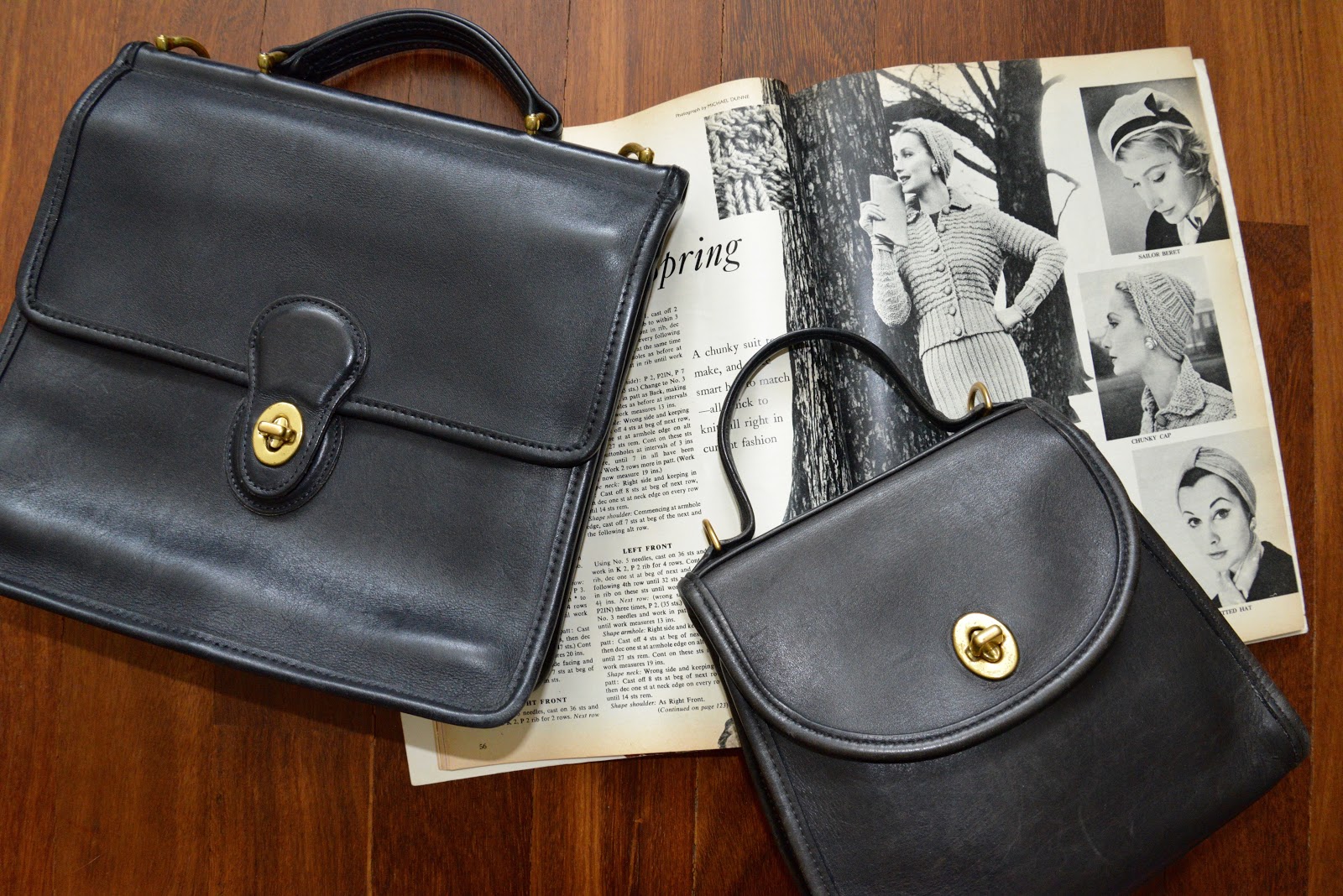
Today I would like to talk about the original range of Coach handbags. For me, the ideal bag is one that is simple, durable, versatile and timeless. The Coach Classics line, as these handbags are generally referred to, fulfil all these requirements perfectly. Founded in New York City in 1941, Coach thrived on their leather-handling expertise and became known for creating finely-crafted but practical accessories. Regarded today as a distinctly American brand, with a national tie similar to Tommy Hilfiger or Michael Kors, Coach remains up-to-date with changing fashions and advertising strategies (remember their Fall 2013 campaign with Karlie Kloss and Liu Wen - I loved it... but maybe that's because I was born in NYC!).
However, as much as I value the Coach brand and wish it continued success, I cannot help but notice that the designs which capture my heart most, are no longer available. A proud possession in the 80s and 90s, these simple, undecorated, classic bags were believed not to appeal to the more frivolous styles of the early 2000s and were substituted for accessories made of combined materials monogramed with the letter "C". While these new designs did become fashion favourites themselves, let's not forget that fashion is cyclical and less is (always) more. After a decade and a half, demand for timeless simplicity and designs that last unsurprisingly returned. Coach has since attempted to create an updated version of its classic line and launch models which borrow design features from the originals. Although some of Coach's modern bags do occasionally tempt me, it is the vintage ones that are forever etched in my memory!
My own first acquisition from the Coach Classics line was the Willis bag and then the Regina model. Pictured in the title photograph, they are both made from black cowhide leather and were purchased online -- the former on Asos Marketplace and the latter through Ebay. I filmed a video (below) featuring additional information as well as reviews of both bags for anyone considering acquiring one. The full range of classic bags contained more than the five models pictured in the photograph below and I often stumble upon alternative versions that fit seamlessly into the line. It truly must have been a very popular bag.
Below: An excerpt from a catalogue advertising the Shoulder Purse.

https://forum.purseblog.com/threads/authenticate-this-coach.818914/page-174

https://s-media-cache-ak0.pinimg.com/originals/4e/7a/0a/4e7a0a035361bfdbfab3912d1566c3d6.jpg

http://www.extrapetite.com/2013/02/vintage-coach-review-shopping-care.html

http://the-atlantic-pacific.com/2011/08/25/jacket-gap/
Above: A photo from an outfit post by Blair, writer of the blog Atlantic-Pacific, from August 2011 - the bags made a brief comeback around this time and they have been on my radar ever since.


A few years ago I bought a netted, crotchet, mesh, fishing, whatever-you-want-to-call-it bag. I saw it out of the corner of my eye in a boutique in Warsaw and although it was a bright fuchsia colour, and I usually go for versatile blacks or browns, I bought it! And I remember why too. There were a couple of reasons. Firstly, I knew it was an accessory worn in the past that would fit my vintage-style outfits, and secondly, it was an item I distinctly remember my grandmother talk about using. I never, however, imagined it would become such a trendy accessory within the next few years. And boy do I love it when items used daily in the past become desirable and fashionable again - which seems to be the case here!
Above: A newspaper advert for the crotchet bag, c. late 1930s - early 1940s.
http://ic.pics.livejournal.com/lunteg/16589014/133959/133959_original.jpg
The bag itself was already in use in the 1930s, especially for everyday food shops or visits to fruit and vegetable markets. It was also a typical summer accessory, used to carry towels and a few bits to the beach. One of the bags advantages is its ability to significantly expand and shrink in size. The way it is designed allows it to widen, a bit like stretching out a fishing net, to accommodate bulky items or awkwardly shaped fruits. It actually has a particularly nostalgic connotation in Poland, which is where I live, because it was a type of bag often carried by people throughout the communist regime (i.e. the 1950s to 1980s) - which is why I remember my grandma talking about it. She fondly recalled the peculiar little bag that that accompanied her on grocery trips to stores with not enough stock (not such a fond memory). I love to reminisce about stories my grandma told me and the fact that this style of bag reminds me of them is heartwarming. That's what I like about old items - they carry a story. So if you want to bring back a bit of the past, all the while keeping up with the latest trends, then I think this practical purchase is one to make.
I saw versions of the bag appear in stores such as H&M and recently noticed it on Instagram too. This really is proof that a great invention never ceases to amaze, even if it's as simple as a cotton (or 100% recycled polyester - it's nice you are trying to care for the environment H&M) crotchet bag.

H&M mesh shopper bag made from 100% recycled polyester (Summer 2017 collection).
http://www2.hm.com/en_gb/productpage.0488493002.html#Light%20blue
Accessed on 9/06/2017
Subscribe to:
Posts (Atom)


Social Icons