

A seemingly simple hairstyle, the high ponytail, combed tightly towards the back of the head was all the rage among teenagers during the late 1950s. Setting new trends in order to break away from uncomfortable starched petticoats and arduous time-consuming hairdos, contemporary youth used their new fashions to turn their backs on conservative ideals and set themselves apart from the pre-war-born generation of their parents. The high ponytail is arguably the most "modern" of vintage hairstyles and one that has to this day retained its cool-factor and universal appeal.

For a long time monogramming personal objects was not only a symbol of ownership. Engraved objects were seen as more precious and valuable and therefore, aside from one's own initials, it was common to engrave the date of a memorable occasion, an intimate phrase, family crest or a dedication. All in an effort to add personal value to an otherwise easily reproduced item. Until the 1950s objects would often come with a small empty plaque allowing one space for a small engraving -- typically two or three letter initials. Usually these were the small, everyday items, such as cigarette cases, jewellery, notebooks, powder compacts, glasses cases, watches as well as travel items such as suitcases, vanity cases, storage boxes and bags. Initials could then be engraved, embossed or embroidered onto an empty name tag or a purposely-designed plaque. While the latter two methods are still frequently in use today, it is engraving that has become a phenomenon of the past.
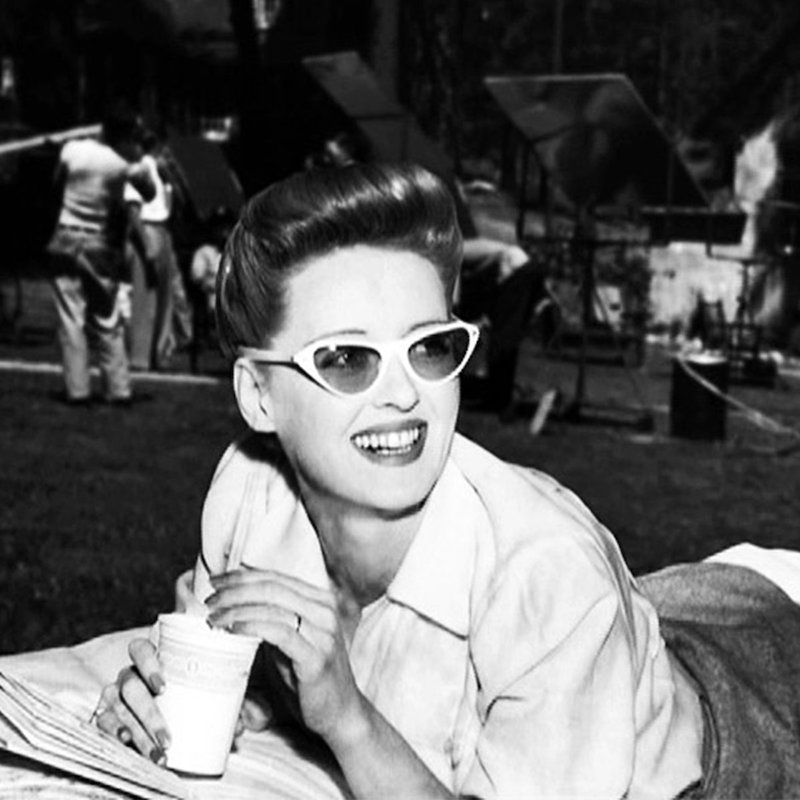
If there has ever been one actress who made sure she protected her eyes from potentially harmful UV rays then it has to be Bette Davis. Fortunately for her sunglasses were not only worn to remain safe in the presence of the bright Californian sun, they became an expression of her unique style and quirky personality too. For who else, if not Bette Davis, could be seen as a more original and frank character in Hollywood during the Golden Age of film.
Above: Davis sipping a drink on the set of Now, Voyager, 1942.
https://therake.com/stories/icons/bette-davis-stars-eyes/
From the quintessentially 1930s perfectly round shades to a pair of super slim cat eyes, that bear an uncanny resemblance to the styles visible all over Instagram today, Bette Davis undoubtedly had an affinity for this small fashion accessory. And rightly so, because it seems as though sunglasses are all she needed to complete her laid back but never careless stylish ensembles every day. Honestly, it is difficult to be surprised -- sunglasses are a great invention, it's just a matter of remembering to take them before leaving one's house in the morning!

Davis eating an ice cream, c. 1933.
https://www.pinterest.com/pin/214484000974647444/

Davis strolling in the summer, 1930s.
https://hiveminer.com/Tags/academyaward%2Cvintage

Davis knitting most likely on the set of The Old Maid, 1939.
http://historyknits.blogspot.co.uk/2010/04/knitting-before-and-behind-camera.html

Davis enjoying a cup of tea, 1940s.
https://www.pinterest.fr/pin/16677461103953777/

Davis on the set of Hush... Hush, Sweet Charlotte, 1964.
https://twitter.com/theoldhollywood/status/838550798397292545

Davis with a falcon, c. 1970.
https://mattsko.wordpress.com/2012/12/31/bette-davis-with-an-awesome-pair-of-sunglasses-and-a-falcon/

Davis attending the Cannes Film Festival with her oldest daughter, B.D., in 1963.
https://edition.cnn.com/2017/03/03/entertainment/bette-davis-joan-crawford-feud/index.html

Davis with her personal assistant Kathryn Sermak, 1980s.
https://www.gettyimages.co.uk/detail/news-photo/bette-davis-with-her-personal-assistant-kathryn-sermak-news-photo/110462069?#bette-davis-with-her-personal-assistant-kathryn-sermak-picture-id110462069
Some of my favourite Bete Davis films, all of which I highly recommend, include:
Ex-Lady (1933)
Front Page Woman (1935)
Now, Voyager (1942)
All About Eve (1950)

If you read this blog you will know that I am always on the hunt for pieces that resemble vintage products sold in the past. From time to time I come across a rare gem that has remained unchanged throughout many decades. Such was the case with this bottle of perfume. I wrote an earlier blog post about Coty's L'Aimant scent, where I stated that I am not yet converted to the often strong odour of vintage perfumes... except for one. The time has come to reveal the secret scent!
The smell in question is that of No. 4711's eau de cologne -- the toilet water hailing from the city of Cologne in Germany which quite naturally lends it its name. It can therefore be called the original eau de cologne, the one that led the way for future competitors, and became an icon in it's own right. Created by Italian perfumier Johann Maria Farina who opened business in 1709 in Cologne, Germany - the perfumed water was the first of its kind. The success of the innovative concoction was so great that it became a regularly ordered cosmetic, forming the toilette of many a king, nobleman or fashionable lady. Although today No. 4711 is seen as a fragrance directed at women, this was not always the case and for a long time it was used by both ladies and gentlemen.

No. 4711 cologne advert, c. 1911.
https://www.pinterest.com/pin/87538786482143204/

French advert for No. 4711 cologne, c. 1930.
https://www.pinterest.com/explore/4711-cologne/

A Polish ad for No. 4711 hair dye, featured in "Światowid" magazine, 13 June 1931, my personal collection.

A Polish ad for No. 4711 eau de cologne, featured in "Światowid" magazine, 13 June 1931, my personal collection.
Above I have included two advertisements from my personal collection of historical magazines. Both were featured in the Polish magazine "Światowid" (13 June 1931). Published in Kraków, the magazine ran from 1924 to 1939 and took on the form of a weekly chronicle which covered both domestic and international affairs. The first advert is actually for hair dye and states that the dye is made from nut extract and is able to dye hair from the lightest of blond to the blackest of black. The second advertisement is for the typical eau de cologne and it recommends to use the product in your morning bath or to rub your body with it in order to wake up the senses and feel energised. At the bottom of the advert it reminds buyers to check the patented blue-gold label and notes that the cologne is made entirely in the village of Dziedzice (located in the Silesian region of Poland) whose history extends as far back as the Middle Ages!
From the various publications one can see that No. 4711 was available all across Europe. Not only that, it was also able to retain it's status as a luxurious and one-of-a-kind perfume throughout the years. Although tastes have changed and it's name does not elicit the same joyous reaction it did a while ago, the company's headquarters, located in a six-floor building in Cologne, are regular visited by eager tourists and perfume aficionados. It's iconic bottle carries such an aura of glamour and modernity that it is no surprise that it is frequently used by set designers in film and theater. Most recently I saw it in the series Mr. Selfridge, where it occupied the majority of the famous department store's cosmetics counter.

No. 4711 cologne "Art of Living" advert, c. 1970.
http://www.vintageadbrowser.com/perfume-ads-1970s/5
Below: Stills from the television series Mr Selfridge, available on Netflix.


Exactly the same perfume is still available, both in store and online, at Boots - although not for £3.


It's a known fact that trends in fashion repeat themselves, but I have never noticed it more than during recent scrolls down clothing store websites. Perhaps I am simply more atune to the fashion fads of the past, whatever the reason, I am beginning to come to the conclusion that being fashionable is a temporary, exhausting and boring thing. What truly counts is having an original sense of style, being able to combine pieces that appeal to you and in turn creating a look that best expresses your aesthetic, your personality and your interests. So if you love berets then just wear them, you might be surprised to find out that in a few years time they will make a comeback (as they have now) and lo and behold you will be at the forefront of fashion... until something else takes over of course.
Below is a round up of a couple of items which reminded me of historical fashions. Direct links to the items are featured below each photo. What else would you add to this list?

The largest shopping mall near my home is called Galeria Mokotów. Not only is it relatively easy for me to reach but it also happens to have a rather good selection of stores and clothing brands. Unsurprisingly, last week, when my best friend was in town, we decided to stop by and pick up a few last minute Christmas presents. We were walking from one shop to the next when a small photograph depicting a 1950s fashion show, carefully displayed on a little podium, caught my eye. I looked up and saw three enormous black and white posters hanging from the ceiling -- they portrayed fashion photography from the 1960s. I was much perplexed. Only a minute later did it sink in -- I was standing in the middle of a fashion photography exhibition, right in the centre of a shopping mall! The exhibition was designed around a circular rotunda which accommodated one of the many escalators. Along the balustrade small podiums were arranged showcasing Polish fashion photographs from the mid-1950s to 1988. It was, however, primarily the aforementioned, ceiling-hung blown-up images that caught the curious eyes of passersby. I noticed leaflets strewn around the floor describing the exhibition and its title. (Pictures of the leaflets and the design of the installations are at the end of this post.) From there I learned that the project was part of a newly founded initiative called The Designer Gallery, which is headed by fashion show choreographer Katarzyna Sokołowska. The exhibition itself, however, was curated by Agnieszka Ścibior, leading stylist and creative director at Viva! Moda magazine. After my friend left to catch her bus, I ran back and photographed the entire installation in order to write this blog post, so here we go!
Above: Photograph by Władysław Sławny, Presentation of Polish clothing companies at the Parisian Fairs, Paris, France, May 1973. Forum Archives.
Above: Photograph by Władysław Sławny, Presentation of Polish clothing companies at the Parisian Fairs, Paris, France, May 1973. Forum Archives.
Subscribe to:
Posts (Atom)


Social Icons